

Editor’s Note: This article reflects publicly available information on Iowa Senate File 2426 as of April 8, 2026, including the most recent Senate amendment. We will update this article as additional details become available. Readers are encouraged to monitor the Iowa Legislature’s official website for the latest status.
What Is Iowa Senate File 2426?
Iowa Senate File 2426 (SF 2426) is state-level legislation that would establish one of the most aggressive English Language Proficiency (ELP) enforcement frameworks in the country. The bill ties English proficiency not only to CDL issuance and renewal, but also to direct consequences for motor carriers when violations occur.
In late March, the Iowa House passed an amended version of the bill requiring CDL applicants to pass a computer-based English exam before obtaining or renewing their license. That version also introduced penalties of up to $10,000 per violation for carriers that employ or contract with drivers who do not meet the applicable standard.
On April 8, 2026, the Iowa Senate passed its own amended version. The Senate amendment keeps the overall structure intact, but it clarifies how enforcement will work in practice, particularly as it relates to carriers. What emerges is not just a licensing requirement, but a framework that ties driver qualification directly to real-time operational consequences.
Why This Bill Matters to Iowa Carriers
This legislation is developing alongside a significant shift in federal enforcement. Since June 25, 2025, when the Commercial Vehicle Safety Alliance re-added English Language Proficiency violations to its out-of-service criteria, enforcement activity has increased substantially. More than 17,000 ELP out-of-service violations have been issued nationwide, and Iowa has consistently ranked among the more active states. According to Trucksafe’s ELP data tracker, Iowa currently ranks 11th with 521 violations since enhanced enforcement began.
That context matters because SF 2426 does not replace federal enforcement. It adds another layer. The same roadside interaction that results in a federal out-of-service order can now carry additional consequences at the state level, including penalties and restrictions that apply directly to the carrier.
For motor carriers operating in Iowa, this law, if ultimately passed, creates a combined enforcement environment that is both immediate and difficult to predict.
Iowa’s Enforcement Framework Is Taking Shape
As SF 2426 has moved through the legislature, the enforcement framework has come into sharper focus. The House and Senate versions approach carrier enforcement differently, and understanding that distinction is important for evaluating where the bill now stands.
The House version emphasized broad accountability. It paired the CDL testing requirement with significant monetary penalties and contemplated more expansive enforcement tied to a carrier’s use of non-proficient drivers. That approach raised the possibility of consequences that extended beyond a single roadside event and into the carrier’s overall operations.
The Senate amendment takes a different approach. It retains the core prohibition on using non-proficient drivers and preserves the penalty structure, but it focuses more directly on how enforcement plays out when a violation occurs on the road. Instead of building out a broader regulatory framework, it defines what happens in that moment and what the carrier must do to resolve the situation.
Under the Senate amendment, a motor carrier may not employ or engage a driver who does not meet the English language proficiency requirements of 49 CFR 391.11(b)(2). A violation is classified as a serious misdemeanor and is also subject to a tiered civil penalty structure that increases with repeated offenses.
Those penalties are meaningful, but they are only part of the picture. The more consequential piece is the out-of-service authority that applies at the carrier level. If a violation is identified, the state may issue an order prohibiting the carrier from operating commercial motor vehicles in Iowa until the violation is corrected or the applicable penalty is paid. This is not limited to the individual driver involved in the stop. It is a restriction that applies to the carrier’s operations within the state.
This is where the bill departs from traditional enforcement expectations. In most cases, English proficiency issues are addressed at the driver level, with the immediate consequence being an out-of-service order for that individual. The Senate amendment extends that impact to the carrier, making the company’s ability to continue operating in the state contingent on how the violation is handled.
What That Looks Like in Practice
Viewed in practical terms, the impact becomes clearer. A driver is stopped and evaluated for English proficiency in Iowa. If the driver is found to be non-compliant, the driver is placed out of service. At that point, the issue does not stop with the driver. The carrier is now facing potential graduated penalties and a restriction on its ability to operate within Iowa until the situation is resolved.
That forces immediate decisions. The carrier must determine how to move the load, whether a qualified replacement driver is available, and how quickly the violation can be addressed or the penalty satisfied so that operations can resume.
This is not something that can be pushed to a later compliance review or handled through routine back-office processes. It is an operational disruption that unfolds in real time, with direct consequences for service, customer relationships, and revenue.
Federal Enforcement Is Already Creating Pressure
The timing of this legislation amplifies its impact. Since enhanced federal enforcement began in June 2025, ELP out-of-service violations have increased sharply. Monthly totals have climbed from a few hundred to well over two thousand, reflecting both increased attention and more consistent application of the standard.
At the federal level, enforcement remains inherently subjective. Inspectors begin with a conversational assessment and may proceed to road sign recognition testing. There is no fixed scoring system, and outcomes can vary depending on the officer and the circumstances.
Iowa’s approach attempts to introduce more consistency at the licensing stage through standardized testing, but it does not eliminate the variability carriers face once drivers are on the road. Instead, it adds defined consequences on top of an existing enforcement structure that remains, at its core, judgment-based.
The Risk Is Both Financial and Operational
The financial exposure under SF 2426 is straightforward. Civil penalties escalate with repeated violations and can reach $10,000 per occurrence. When combined with the costs associated with an out-of-service event, including driver replacement, equipment recovery, and service disruption, the total impact of a single incident can quickly exceed that amount.
The operational risk is less predictable but potentially more significant. A carrier-level out-of-service order, even if limited to a single state and tied to correction or payment, can disrupt routes, delay freight, and strain customer relationships. For carriers that rely on consistent movement through Iowa, particularly along major freight corridors, that potential disruption is not incidental.
Intrastate vs. Interstate: Why This Still Matters
There is a tendency to view state-level CDL legislation as primarily affecting intrastate carriers. In practice, the enforcement provisions apply to operations occurring within the state, regardless of where the carrier is based.
Interstate carriers moving freight through Iowa are subject to Iowa enforcement while operating on Iowa roadways. A driver holding a valid out-of-state CDL can still trigger state-level consequences if found non-compliant under the applicable standard. This creates a layered compliance environment in which federal and state requirements intersect. A single roadside event can carry multiple consequences, and carriers must be prepared to navigate both.
Building a Defensible Approach to ELP
Given this environment, English language proficiency needs to be treated as a front-end qualification issue rather than something addressed only after a violation occurs. That begins with the hiring process, but it also requires a consistent approach to evaluation and documentation throughout the driver’s tenure. Carriers should be able to demonstrate how proficiency was assessed, what standards were applied, and how those determinations were documented.
This is not only a compliance issue. It is increasingly relevant in litigation, where questions about what a carrier knew or should have known regarding a driver’s qualifications can become central. ELP is becoming part of that analysis, and carriers that lack a documented process may find themselves at a disadvantage.
ELPReady: Assessment Before Enforcement
ELPReady by Trucksafe is designed to provide a practical way to address this issue before it becomes an enforcement event. The cutting-edge, AI-based platform allows carriers to evaluate English proficiency using a process that mirrors how roadside assessments are conducted, while also creating a documented record of the results.
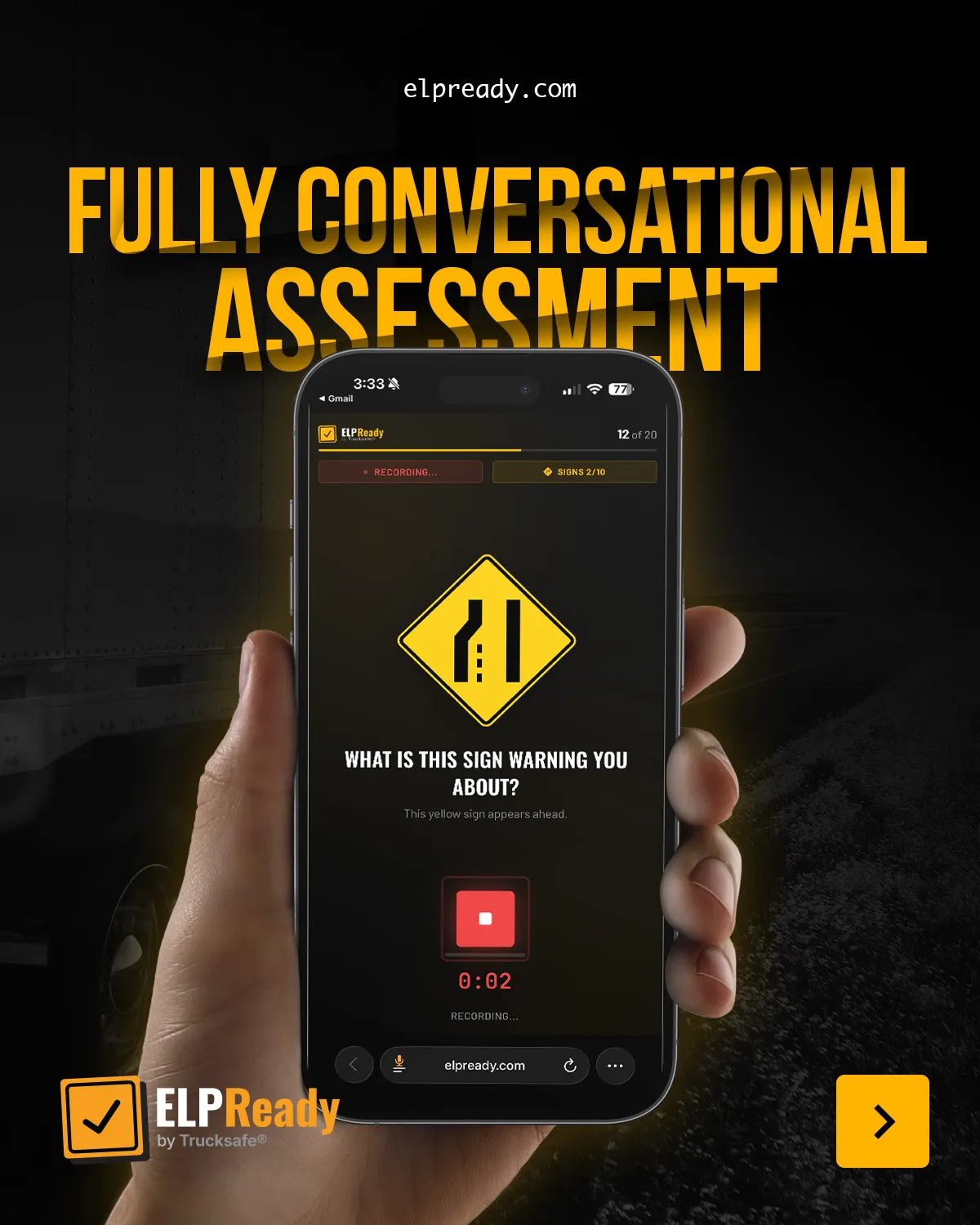
Drivers complete a short, voice-based evaluation on their phone, and the system records and scores the interaction. The results can then be stored as part of the driver qualification or personnel file, providing both operational insight and documentation that reflects a consistent approach to compliance. Try it out for free here.
What Fleets Should Do Now
SF 2426 reflects a broader shift in how English language proficiency is being enforced. States are beginning to take a more active role in an area that has traditionally been handled at the federal level, and the direction of that shift is becoming clearer.
Carriers should not wait for final passage to begin addressing the issue. The enforcement environment is already active, and the addition of state-level consequences only increases the need for a proactive approach. That includes evaluating the current driver pool, implementing consistent assessment processes, ensuring that documentation is complete, and monitoring developments in Iowa and other states that may adopt similar frameworks.
Iowa's pending legislation makes clear that English language proficiency is no longer just a driver-level issue handled at roadside. It is a carrier-level risk that can affect operations in real time. When a violation occurs, the consequences extend beyond the individual driver. The carrier faces penalties and may be restricted from operating within the state until the issue is resolved. That substantially escalates the nature of the risk.
How Trucksafe Can Help
Keeping up with evolving state and federal enforcement is challenging, particularly as the two begin to overlap in new ways. Trucksafe Consulting helps carriers translate those developments into practical compliance strategies, from assessing the impact of new legislation to implementing defensible driver qualification processes. We will continue to update this article as SF 2426 moves toward final passage. Check out all our current ELP resources here.
