
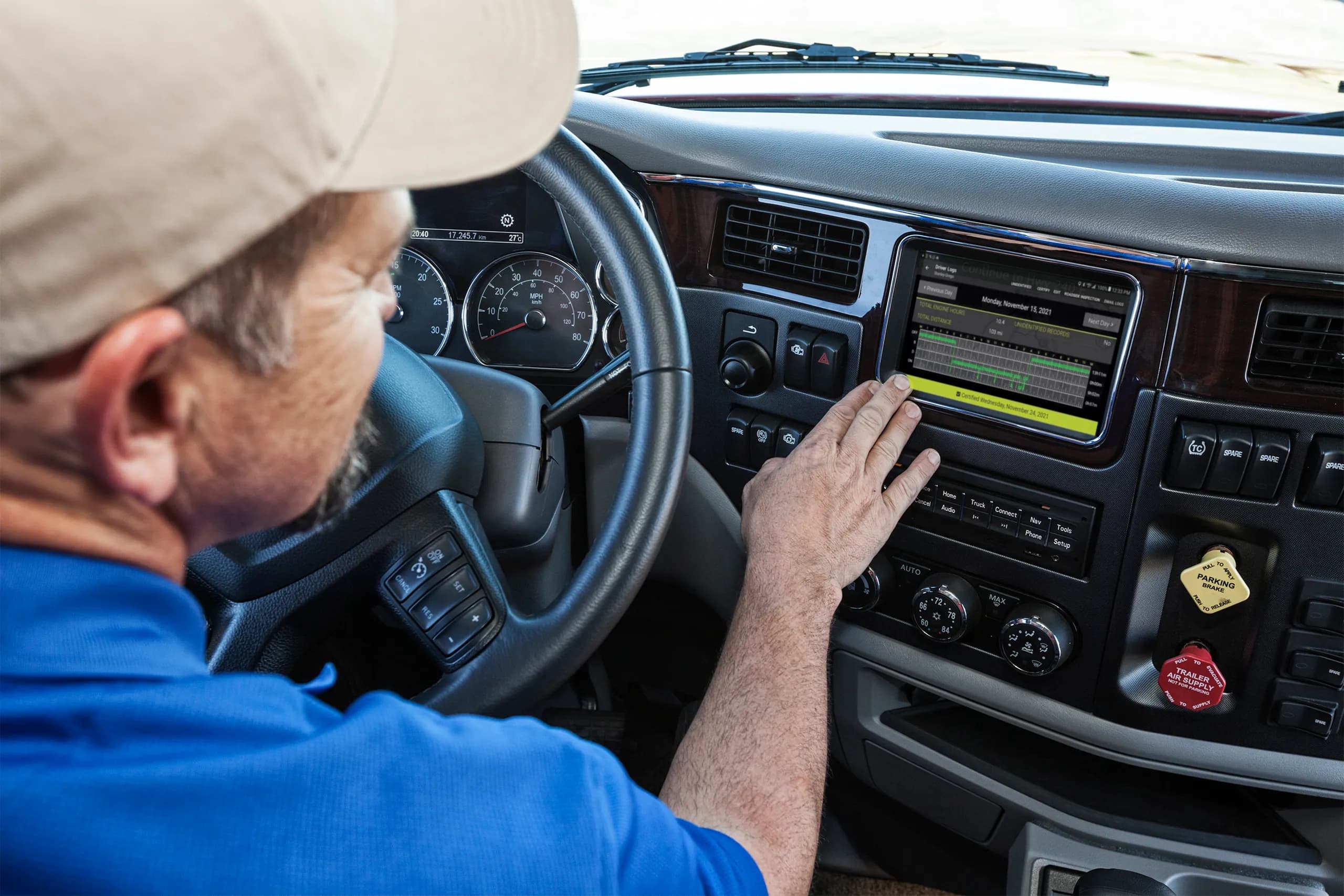
The Federal Motor Carrier Safety Administration (FMCSA) has issued a final disposition denying an application from the Federation of Professional Truckers (FOPT) that sought to allow commercial drivers to record their hours of service manually using paper logs instead of the federally mandated electronic logging device (ELD). The decision, published in the Federal Register (Docket No. FMCSA-2025-1282), represents a significant reaffirmation of the ELD mandate and the agency's commitment to data-driven safety enforcement.
What FOPT Requested
FOPT submitted an application for exemption from the ELD requirements under 49 CFR 395.8(a)(1)(i), which requires drivers who must prepare records of duty status (RODS) to do so using an ELD. The organization sought a broad exemption that would give professional drivers the option to revert to manual, paper-based logbooks as an alternative to ELDs.
Under existing regulations, a limited exception already exists: carriers may allow drivers to keep paper logs if the driver operates a commercial motor vehicle (CMV) requiring RODS completion on no more than 8 days within any 30-day period (49 CFR 395.8(a)(1)(iii)(A)(1)). FOPT's request went significantly further, seeking a broad, voluntary opt-out from ELD use for any driver who wished to participate.
The Public Comment Record
FMCSA received 901 public comments on the application, 890 of which were unique. The majority of individual commenters supported granting the exemption, while major safety organizations and industry associations were largely opposed.
Arguments in Favor of the Exemption
Supporters of the FOPT request raised several recurring themes:
Driver stress and autonomy: Many drivers argued that ELDs create pressure to maximize miles and "beat the clock," reducing flexibility and potentially leading to unsafe decisions. One commenter, Samuel Thorne, wrote: "Without ELDs being required, that puts control back into the drivers hands. Even if they technically have hours to drive or work, they don't have to be forced to work when it's unsafe to do so."
ELD reliability concerns: Commenters cited frequent ELD malfunctions, decertifications, and alleged damage to truck ECMs as evidence that the devices are imperfect tools. Lazar Gacevski stated that ELDs "malfunction all the time due to numerous technical issues," providing "false information of available driving hours" that affects load planning and road safety.
Financial burden: Small carriers and independent contractors pointed to ELD costs as a disproportionate burden, particularly for those operating under small carrier authority.
Truck parking: Several commenters connected ELD pressure to the national truck parking crisis, arguing that drivers are forced to park illegally when their clocks run out in areas without available parking.
Arguments Against the Exemption
Safety advocacy groups and industry organizations presented a unified front in opposition:
The Truck Safety Coalition, Citizens for Reliable and Safe Highways, and Parents Against Tired Truckers jointly criticized the application for failing to define the scope of the exemption, including the number of carriers, drivers, or miles that would be affected, and for lacking any meaningful safety assurance framework for participants.
The American Trucking Associations (ATA) pushed back on the "beating the clock" argument, noting that hours-of-service regulations are unchanged whether a driver uses an ELD or paper logs, and that proper route planning within HOS limits is the responsibility of fleets and drivers regardless of the logging method.
The Institute for Safer Trucking and Road Safe America called ELDs "a data-driven, effective tool for reducing fatigue-related crashes, improving compliance, and increasing accountability," urging FMCSA to deny the request.
The Buchanan Law Firm, LLC cited FMCSA's own 2023 Report to Congress, which found that inspections with at least one hours-of-service violation fell from 274,441 in 2018 to 191,797 in 2020, a statistically significant decrease attributed in part to ELD adoption.
Why FMCSA Denied the Exemption
FMCSA's denial rests on two distinct and mutually reinforcing grounds.
1. Congressional Mandate Under MAP-21
The ELD mandate is not simply an FMCSA regulatory preference; it is a Congressional directive. Section 32301(b) of the Commercial Motor Vehicle Safety Enhancement Act, enacted as part of the Moving Ahead for Progress in the 21st Century Act (MAP-21, Pub. L. 112-141, 2012), mandated that the Secretary of Transportation adopt regulations requiring ELDs in CMVs involved in interstate commerce operated by drivers required to keep RODS. FMCSA concluded that this legislative mandate prevents the agency from granting a blanket exemption to any driver or carrier that simply wishes to opt out.
2. Failure to Demonstrate Safety Equivalency
Under 49 U.S.C. 31315(b)(1), FMCSA may only grant an exemption if it would likely achieve a level of safety equivalent to, or greater than, what would be achieved without the exemption. FOPT's application did not meet this standard, according to the agency.
While FOPT proposed safety countermeasures including member education on paper log accuracy, random internal audits, and exclusion of violators from the exemption program, these measures were fatally undermined by the scope of the request itself. FOPT proposed that the exemption apply to all drivers who wanted to use it, not just FOPT members. The agency found that FOPT provided no explanation of how its internal safety controls would apply to an unknown and potentially unlimited population of non-member drivers, or how violators could be identified and excluded.
FOPT does not explain how its proposed safety countermeasures would apply to an unknown population of drivers or how violators would be excluded from the exemption program.
What This Means for Carriers and Drivers
This decision confirms that ELD compliance remains a non-negotiable requirement for drivers subject to RODS obligations under federal hours-of-service regulations. Carriers and drivers should take note of the following practical points:
The ELD mandate stands: There is no pathway to a broad, voluntary paper log exemption. Carriers operating CMVs in interstate commerce must maintain compliant ELDs for all RODS-required drivers.
The short-haul exception still applies: Drivers who require RODS on no more than 8 days in any 30-day period may still use paper logs under the existing regulatory exception at 49 CFR 395.8(a)(1)(iii)(A)(1).
ELD malfunctions have a process: If an ELD malfunctions, drivers are required to reconstruct RODS on paper for the malfunction period and the carrier must repair or replace the device within 8 days. Having a malfunction protocol in place is essential.
HOS compliance is the real issue: As the ATA and FMCSA both noted, HOS regulations are the same regardless of the logging method. Pressure to "beat the clock" is a symptom of scheduling and dispatch culture, not the ELD itself. Safety directors should address those operational pressures directly.
The Bottom Line
FMCSA's denial of the FOPT exemption application is a clear signal that the agency views ELDs as a cornerstone of its hours-of-service enforcement strategy, one backed by both congressional authority and measurable safety data. Carriers who were watching this application hoping for a return to paper logs should plan accordingly: ELDs are here to stay, and robust compliance programs built around ELD use remain the standard expectation for regulated carriers.
If your fleet has questions about ELD compliance, managing malfunction situations, or navigating hours-of-service requirements, contact Trucksafe Consulting for expert guidance.
